[ad_1]
India’s examination system rests on a tenuous assumption that students will be treated fairly, even if the results are disappointing. Once that belief is weakened, every mark, every grade, and every assessment begins to invite doubt. Controversy surrounding the Central Board of Secondary Education (CBSE‘s) On-Screen Marking (OSM) system has now entered exactly that territory.In what began earlier this month, complaints about mismatched marks and poorly scanned answer sheets have now spilled over into allegations that schools were informally encouraged to publicly defend the online system. According to several principals across Delhi, CBSE regional officials reportedly contacted schools through phone calls, WhatsApp groups and informal communication channels, urging them to post positive messages about the digital assessment process and reassure students and parents.Various media reports said that an intended statement circulating in the schools described the transition to digital assessment as “a monumental change” that has “fundamentally improved the structural integrity of our assessments”. The statement also reportedly claimed that the system “completely eliminates human cognitive errors” and urged institutions to “accept these digital developments with patience” and “trust the system”.The controversy comes at a time when the OSM system is already facing scrutiny over complaints of blurred answer sheets, missing scanned pages, wrong marking and in some cases alleged mismatch between physical and digital copies of answer books. Students across the country have questioned whether a system introduced to improve transparency and efficiency has instead created a new layer of uncertainty.
Technical failure or narrative engineering?
This current episode is important not only because of what schools were allegedly told to reassure the public, but because it suggests an institutional priority that focuses more on controlling perceptions than addressing structural concerns.A principal of a private school in Delhi claimed, citing media reports: “We were told verbally to reassure parents and students and highlight the positive aspects of OSM.” Another principal reportedly said there was a “clear sense that schools should help calm the narrative”.Educational institutions are expected to alleviate panic during moments of confusion. But there’s a difference between communicating responsibly and appearing to coordinate public messaging while students continue to report unresolved grievances.Several principals reportedly said schools are simultaneously dealing with worried parents, helping students with the retest portal and responding to complaints about incomplete answer sheets, even as they are publicly encouraged to instill confidence in the system. “Parents are coming to us with real concerns, but there’s pressure to provide reassurance online,” one principal reportedly said.The institutional response has therefore created another layer of conflict. The issue is no longer limited to whether the technology is flawed. It’s increasingly about whether criticism is being self-administered rather than being meaningfully addressed.
The system is already under pressure.
The allegations come in the backdrop of growing controversy surrounding the CBSE’s decision to implement full-scale digital assessment for Class 12 exams this year.The OSM system works by scanning physical answer sheets and uploading them to a digital platform for evaluation by teachers. According to the board, the aim was to reduce human errors, increase efficiency and standardize assessment methods. But the transition has exposed several operational weaknesses.Students have alleged that scanned copies were faded or incomplete, pages were missing and some answers were not checked. The controversy escalated when a student, Vedanta Srivastava, claimed that the physics answer sheet uploaded to him after the re-examination was not his. He alleged that the handwriting was different from his own and the uploaded copy contained answers to questions he had not attempted.CBSE later said that a “correct copy” was shared with the student. But by then, the incident had already sparked wider public anxiety about the integrity of the assessment system.Over the past week, screenshots, testimonials and videos shared online have heightened those concerns. According to the board, lakhs of students have applied for a scan or physical copy of their answer sheets after the declaration of results.At the same time, questions regarding the preparations have also started to arise. Teachers’ organizations and academics have raised concerns about whether examiners have received sufficient training to assess long descriptive responses through a screen-based interface. Assessing handwritten responses digitally under strict timelines is not the same as traditional paper-based assessment. In subjects that require interpretive judgement, long screen-based assessments may risk reducing assessment to a more mechanical process.Technology can streamline administrative work. This by itself cannot guarantee educational justice.
Public trust cannot be created
Equally damaging to CBSE is the perception that assurance is being prioritized over transparency. Institutional trust in public examinations is built not through promotional messages but through visible accountability.
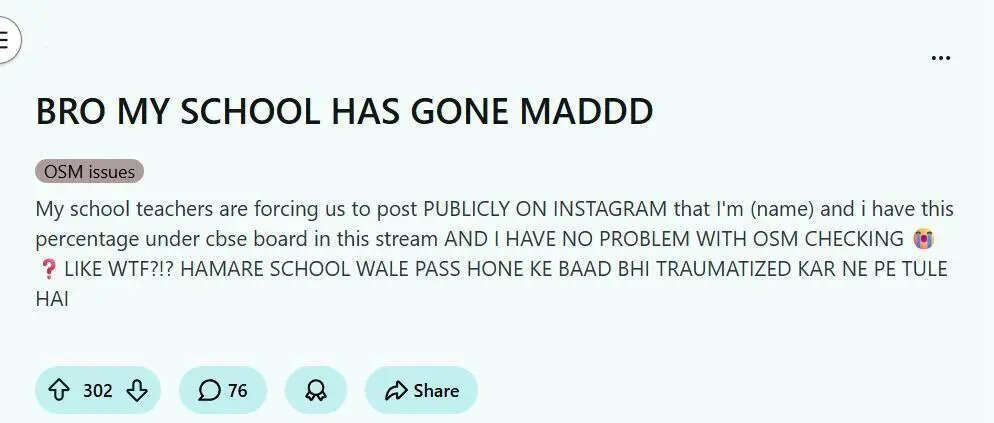
A Reddit post by a student
Social media reaction to the latest allegations reflects this growing mistrust. A Reddit post has been circulating claiming that schools are asking students to post messages online declaring that they have “no problem with OSM checking”. AAP chief Arvind Kejriwal also criticized the development on X, writing: “Instead of accepting the problem and correcting it, they are using children to justify their rotten system.”CBSE has consistently maintained that the OSM process is secure and all genuine complaints are being reviewed on a priority basis. It has also denied allegations of security breaches after a student self-identifying as an ethical hacker claimed to have accessed examiner accounts through vulnerabilities on the testing portal. The board said no real diagnostic data has been compromised.But now the bigger problem has gone beyond a single allegation. The controversy has exposed how vulnerable public confidence can be when exam systems appear opaque in moments of crisis.
The Burden of Institutional Credibility
The results of India’s school examination system are much more than a mark sheet. For millions of students, these results determine admissions, scholarships, career paths and social mobility. In such a system, even isolated anomalies gain disproportionate importance because students experience them not simply as mistakes but as threats to their future.This is why public examinations require more than administrative ability. They require institutions to be transparent, accountable and willing to acknowledge limitations.CBSE’s current challenge is institutional. The more the conflict moves towards managing the narrative rather than openly confronting the shortcomings, the more difficult it becomes to restore trust in the system.Technology can help with assessment, but it cannot replace trust. And once that trust is undermined, no coherent assurance can easily rebuild it.
[ad_2]
Source link