[ad_1]

Modern car keys have changed the way people interact with their vehicles. Now you don’t need to insert a key or press a button in some cases. The car easily detects the nearby key and unlocks itself. It feels smooth and almost effortless. Still, this feature is entirely dependent on wireless communication, which can be weak. As cars get smarter, so do the methods used by thieves. Signal-based attacks, particularly relay attacks, have reportedly increased in recent years. These attacks don’t require physical access to your keys. Instead, they exploit the signals your key fob constantly emits, often without you even realizing it.
How key fobs communicate with your car.
According to information provided by Leicester Auto Locksmith UK, a car key uses radio frequency signals, usually from 315 to 433 MHz. When you press a button, your key sends a coded signal to your car. Your car then performs the requested action. However, for a modern car key, it is not always necessary to press the button. The key simply sends a signal, and detects when your car is close.It is a secure system as the signals are encrypted. However, it is not always a matter of cracking the encryption. In a relay attack, thieves use two devices. A device is near your home and tries to intercept your car key signal. Another device is near your car.
Why can aluminum foil block signal?
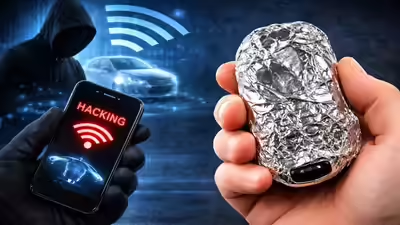
Aluminum foil works because it can act as a primary Faraday cage. A Faraday cage is a structure made of conductive material that blocks electromagnetic signals. When radio waves hit foil, they don’t pass through easily. Instead, they are reflected or absorbed across the surface.This means that the signal from your key fob cannot be transmitted effectively. Still, effectiveness depends on how well the foil is applied. Proper wrapping is essential where even a small gap or tear can allow signals to leak.
How to properly wrap your key fob in aluminum.
To block signals effectively, wrapping must be thorough and secure.
- Start with a piece of aluminum foil large enough to completely enclose the key fob.
- Center the key and fold the foil tightly around it. Make sure there are no visible gaps.
- Adding multiple layers improves shielding. Three to four layers are generally considered sufficient for permanent results.
- After wrapping, testing is essential. Stand near your car and try to open it. If the car doesn’t respond, the signal is likely blocked.
Advantages of using aluminum foil
- Cost Effective: It is cheap and widely available.
- Flexible and adaptable: aluminum foil can fit around any key fob regardless of shape or size.
- You can remove the foil at any time without affecting the device. This allows for general use whenever needed.
- Portable: Even after wrapping, the key fob remains lightweight and easy to carry.
Limitations you should be aware of.
- Despite its advantages, aluminum foil is not the best solution. A common problem is discomfort. Wrapping and unwrapping the key every time you use it feels repetitive and time-consuming.
- Stability is another concern. Foil can tear easily, especially with repeated handling. Small holes can form without being immediately visible, which reduces their effectiveness.
- Moisture can also affect the material over time, especially in humid conditions, which can weaken the insulating properties.
- There is also the matter of appearance. A foil-wrapped key fob doesn’t look particularly neat, and some may find it impractical for everyday use.
Additional measures to improve car safety
Signal blocking is just one aspect of making your car safer. Keeping your keys away from your doors and windows can also reduce the risk of your keys being hacked. Another option that a car owner can consider to increase the security of the vehicle is to park it in a safe place. Car owners can consider installing safety devices in their cars to enhance security.
[ad_2]
Source link