[ad_1]

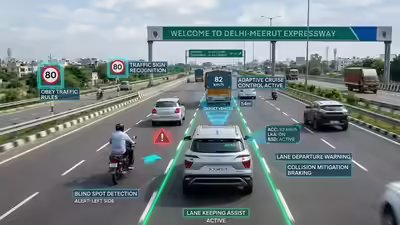
Over the past few years, car buyers in India have started hearing a new term while testing high-end variants: ADAS. What was once limited to luxury cars is now appearing in more mainstream models. Vehicles such as Mahindra XUV700, Hyundai Creta, Kia Syros and Maruti Suzuki Victoris now offer these technologies in some variants. Naturally, manufacturers highlight ADAS as a major safety upgrade. But if you talk to many buyers, one common question still comes up: What exactly does it do, and will it really help on Indian roads? In simple words, ADAS stands for Advanced Driver Assistance Systems. These are electronic technologies designed to assist the driver while the vehicle is in motion. The car uses cameras, radar sensors and sometimes other sensors to monitor its surroundings. If it detects a dangerous situation, the system can warn the driver or step in briefly to avoid trouble. Think of it as a digital co-driver who keeps watching. But let’s be clear. ADAS does not make the car self-driving. The driver still has to be fully alert and in control at all times. So it’s worth understanding how these systems work before paying extra for them.
Key features of ADAS offered in India
Most cars sold in India today offer either Level 1 or Level 2 ADAS. This means that the systems can assist with certain functions such as braking, acceleration or steering, but they cannot be automated. Some common features you’ll see include:
-
Automatic emergency braking (AEB) - Adaptive Cruise Control (ACC)
- Lane Departure Warning and Lane Keep Assist
-
Blind spot monitoring - High beam assist
- Driver attention warning
How useful is ADAS in India?
On paper, ADAS looks very impressive. In reality, its usefulness may depend on where and how you drive. Many of these systems rely on clearly visible lane markings and predictable traffic flow. This is something that Indian roads do not always offer. Lane markings are often blurred, missing, or ignored by drivers. And then there’s our traffic behavior. Two-wheelers cutting through the streets, pedestrians crossing suddenly, stray animals on the highways. You see it all. In such situations, sensors can sometimes struggle to interpret what is happening.Lane-based systems are a good example. They work best when the car can clearly see the lane lines. If the markings are blurred or missing, the system may not be able to detect the lane correctly. Because of this, features like lane keep assist or lane centering may not always behave as expected on many city streets.
Features that can still be very useful.
That said, some ADAS functions can really help in Indian driving conditions. Automatic emergency braking is one of the most practical features. Sudden braking is common in traffic, especially in cities. If the driver reacts to a part too late, the system can help reduce the impact or sometimes avoid the collision altogether. Blind spot monitoring is another useful feature. On highways, motorcycles and small vehicles often pull up to a vehicle without warning. The system alerts you before changing lanes.
Rear Cross Traffic Alert can also come in handy when backing out of parking spaces in crowded areas. Anyone who has ever tried to back out of a tight mall parking space will appreciate this feature. A driver attention alert is also useful. During long highway drives, it can detect signs of fatigue and remind the driver to brake. Many ADAS systems are most effective in built environments. Highways and expressways are good examples. On these roads, features like adaptive cruise control and lane centering work smoothly. Traffic flows in one direction and lanes are usually well marked. In city traffic, however, things can get messy. Vehicles are constantly cutting into lanes and changing speeds. In such situations, adaptive cruise control may feel less useful. Similarly, Lane Keeping Assist can sometimes feel intrusive on narrow roads. Drivers in India often move slightly into the lane to avoid potholes, bikes or pedestrians. When the system tries to correct this movement, it doesn’t always feel natural. So if you’re considering a car with ADAS, think about how and where you often drive. For highway users, this can add real convenience and safety. In crowded cities, some features may be less relevant.
[ad_2]
Source link