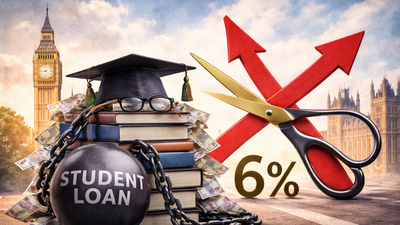
Over the years, the politics of student debt in the UK has turned into a quiet contradiction. Payments are designed to feel manageable—linked to graduates’ earnings. Debt, however, is paid by a different set of rules. It increases with inflation, often going unnoticed until it happens suddenly.That contradiction has now been forced into the hands of the government. Plan 2 and Plan 3 student loans will have an interest cap of 6% starting September for the 2026-27 academic year. The move is intended to prevent the balance from growing too quickly if inflation picks up again. It is, by any measure, a useful intervention. It is also a limited one. The system remains the same. For now only the more uncomfortable edges have been sanded away.
A loan that does not behave exactly the same.
To understand why this matters, it helps to look at how the system works—not in theory, but in practice. There are no fixed monthly installments. Instead, graduates pay back a chunk of their earnings, but only once they cross a certain earnings threshold. Earn less, pay less. Earn nothing, give nothing. After a few decades, what remains is written off.On paper, it sounds humane. And in many ways, it is. But it also produces a strange result. Payoff feels predictable; Total debt is not. One is linked to income, the other to inflation. They fall apart more often than one would expect.
Plan 2, Plan 3: Simple Labels, Complex Results
Most undergraduate borrowers in England and Wales fall under Plan 2 — a system for those who entered university after 2012. Plan 3, despite the clean number, is only a postgraduate loan system. The payout rate is low—6%—and the income threshold is even lower.So far, it’s pretty straight forward. Complexity enters through interest. These loans do not have a fixed rate. Instead, they are linked to inflation, called the retail price index (RPI), which is a statistical measure of changes in the prices of everyday goods and services. When inflation rises, so does interest. And sometimes, it grows rapidly.
When the payment does not reduce the debt
This is the point at which many borrowers begin to feel that something is off. Because interest can be relatively high, especially during volatile periods, it’s entirely possible to make regular payments and still see the total debt inch up. The chips you pay on the loan. What the system returns can sometimes go beyond that.There is also an unevenness in the results. Graduates who go on to earn more are more likely to pay off their loans in full, with interest. Those who earn less may never clear the balance before it is written off.Two people can leave with the same degree and the same initial debt, and pay very different amounts over time. This can be by design. It doesn’t always feel intuitive.
What the hat does and what it carefully avoids doing.
The new 6% cap intervenes at a certain point in the system. This temporarily breaks the automatic link between inflation and interest rates. Even if inflation rises above this level, these loans will not bear interest. This will slow down the growth of outstanding balances. This can make the statements less alarming. However, there will be no change in how much graduates pay each month. Who will reduce what they already owe?This is not debt relief. This is debt prevention. Or, put differently, it addresses the speed at which the problem can grow, not the structure that creates it in the first place.
Who benefits and who less?
As with most such initiatives, the benefits are uneven. People who can pay off their loans in full — typically high earners — benefit most from lower interest rates. Over time, this reduces the total amount they will pay.For others, especially those whose loans will eventually be forgiven, the difference may be less clear. They are paid from income, not from headline interest rates. The policy stabilizes rather than equalizes the system.
Should Indian students worry?
For Indian students, the announcement is more background than breakthrough. The UK’s student loan system is not designed for international students. Eligibility depends largely on residency. Most Indian students prepay, or take out private loans—often in India—on entirely different terms.So the cap does not lower tuition fees or affect private loan rates. It also does not change the cost of studying in the UK. At best, it offers a glimpse of how strained the domestic system has become. It doesn’t change the financial math for those coming from overseas.
An interval, not an axis.
What the government has done is, in essence, to draw a temporary cap on a system that was in danger of becoming politically awkward. This has ensured that student debt will not grow too quickly in the coming year. It doesn’t address why it grows in ways that many lenders struggle to follow in the first place.This distinction matters because systems are not only controversial if they are expensive. They become paradoxical when they are difficult to define, difficult to predict, and difficult to trust. The UK student loan model remains the same.