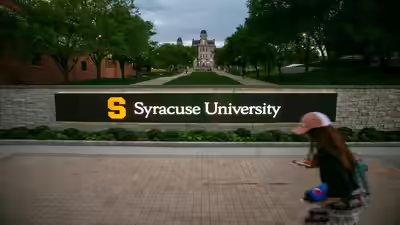
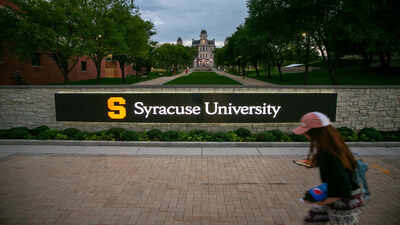
Syracuse University has announced plans to eliminate 93 academic programs, including bachelor’s degrees, graduate offerings, and certificate courses, as part of a strategic overhaul aimed at aligning its curriculum with student demand.According to a report of Higher Ed DiveProvost Louis Agnew said in a campus-wide communication that the move is not due to financial stress, but rather an effort to make the university’s academic portfolio “more focused, more specific and more aligned with student demand.”
Low enrollment drives the decision.
University officials revealed that only 258 students are currently enrolled in the 93 programs to be closed — representing just 1.2% of Syracuse’s total student population of about 22,000.Notably, more than half (55 programs) had zero enrollment, indicating a significant mismatch between course offerings and student interest.Discontinuation programs cover many areas, including:
- Statistics
- Architecture
- Electrical Engineering
- Middle Eastern Studies
- Foreign languages like French, German, Italian and Russian
Breakdown of programs is cutting.
93 programs identified:
- 41 even a bachelor’s degree
- There are 33 certificate programs.
- 19 even graduate-level offerings
Despite the scale of the cuts, the university has confirmed that all currently enrolled students will be allowed to complete their degrees without interruption.
A strategic reset, not austerity.
Unlike similar initiatives at other institutions, Syracuse’s decision comes at a time of financial stability and growth. According to data cited by Higher Ed Dive, the university has consistently recorded budget surpluses since 2018, and has an endowment of $2.3 billion in fiscal year 2025.Before the reorganization, Syracuse offered about 460 academic programs, higher than the average of about 200 programs at comparable institutions.About one-third of the programs account for 80% of total enrollment, Agnew noted, emphasizing the need for stability.
A faculty-led review process
According to Higher Ed Dive, the decision was made after an extensive internal review involving deans and faculty leaders, who evaluated programs on parameters such as academic quality, student demand, and alignment with the university’s broader institutional goals. Provost Louis Agnew noted that the results of this process were not uniform. While some programs have already stopped producing graduates, others will redesign curricula or integrate with related disciplines to improve resources and improve the student experience. He also acknowledged that some decisions are particularly difficult, especially in cases involving programs with dedicated faculty but relatively small student communities.
A transition of leadership is underway.
The announcement comes amid a leadership transition at Syracuse University. Chancellor Kent Syrod is set to step down May 10 to take on a new role at the University of Michigan.He will be replaced by J. Michael Haney, currently the university’s vice chancellor for strategic initiatives and innovation, who will assume his position the following day.
What does this mean for higher education?
Syracuse’s move reflects a broader shift in higher education globally, where institutions are increasingly prioritizing hiring, demand-driven courses, and resource optimization — even in the absence of financial pressures.The decision indicates a growing emphasis on strategic academic curation rather than expansion, as universities realign to respond to changing student preferences and labor market trends.