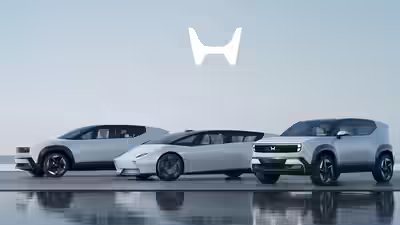
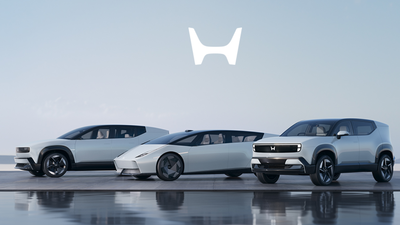
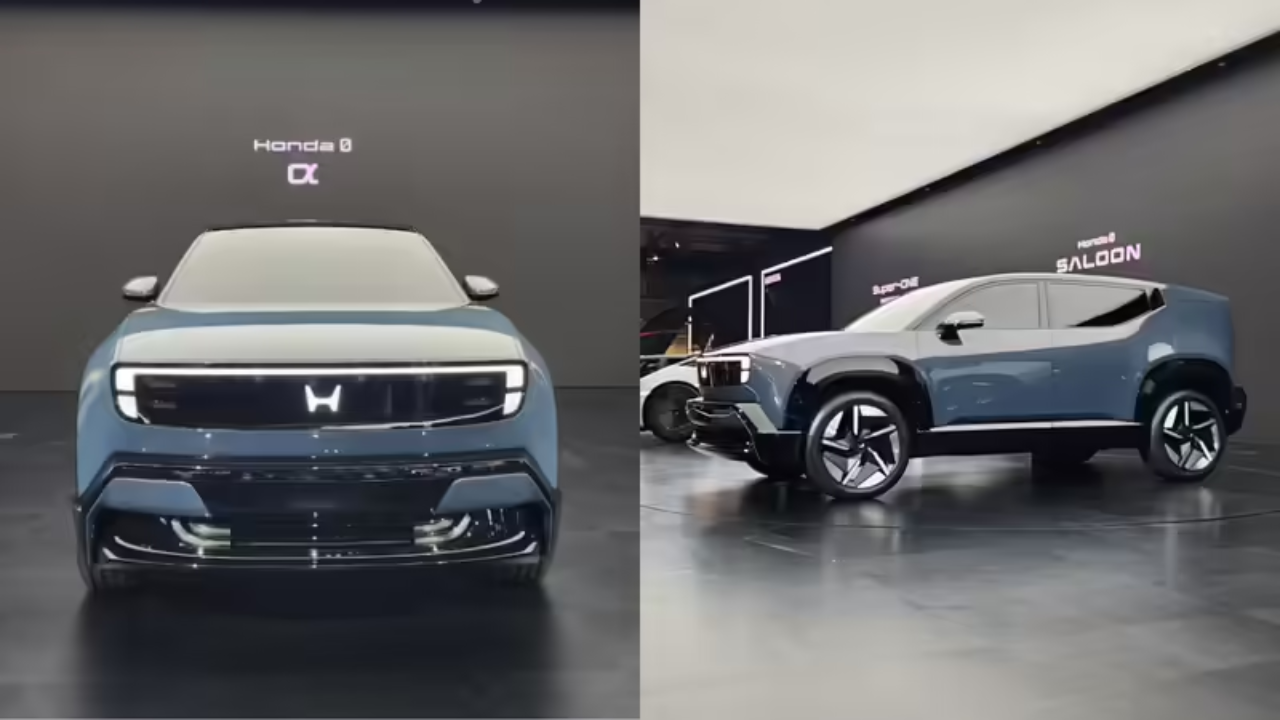
Japanese automaker Honda Motor has announced that it has canceled the production and launch of three electric vehicles for production in North America, citing changes in the business environment and a reassessment of its electrification strategy. The affected models are Honda 0 SUV, Honda 0 Saloon and Acura RSX. Launching these vehicles in the current environment, where demand for EVs has declined, could lead to further long-term losses, the company said.Honda expects the decision to impact its financial results for the fiscal year ending March 2026. The Company expects to record write-downs of assets allocated to these projects and costs associated with canceling their development and production. Operating expenses are estimated at between 820 billion yen and 1.12 trillion yen, while losses from equity investments are estimated at 110 billion to 150 billion yen. Honda also expects special losses of 340 billion to 570 billion yen in its volatile financial results. The company said total losses linked to the reassessment of its electrification strategy could reach 2.5 trillion yen over time.
Honda said profits in its automobile business were hit by changes in U.S. tariff policies affecting gasoline and hybrid models, as well as reduced competition in Asia after devoting more resources to EV development. The company also pointed to the slow growth of the EV market in the United States following revisions to environmental regulations and EV incentives. In China, competition has intensified as new manufacturers focus on software-driven technologies, including advanced driver assistance systems and software-defined vehicles.
As part of its revised approach, Honda said it will strengthen its hybrid lineup while reevaluating EV investments. The company will also focus on improving competitiveness in growth markets like India and plans to introduce next-generation hybrid models in several Asian markets. Honda said EV development will continue from a long-term perspective, with future decisions tied to market conditions and profitability. Despite the financial impact, the company said it will maintain stable shareholder returns and will not revise its dividend forecast for the fiscal year ending March 2026, as it will continue to use the dividend-on-equity ratio as an indicator of its shareholder returns.After revising financial forecasts, some executives will voluntarily return a portion of their compensation. The president and representative executive officers, along with the executive vice president, will return 30 percent of their monthly compensation for three months, while executive officers involved in automobile operations will return 20 percent for the same period. Both senior executives will also forego their short-term performance-linked compensation for the fiscal year, reducing their annual compensation by about 25 to 30 percent. The company also said details of its revised mid- to long-term automobile strategy will be announced at a press conference in May.What does this mean for India?Honda’s decision to cancel three EV models in North America marks a shift in strategy that could affect its approach in India. The company has said it will strengthen its focus on hybrid vehicles while expanding its presence in growth markets such as India. For the Indian market, this suggests that Honda may prefer hybrid technology instead of accelerating a full-scale EV rollout. Honda has also hinted at plans to improve its model lineup and cost competitiveness in India. This could lead to more locally adapted products, including SUVs and hybrid variants suited to local market conditions.At the same time, the company said EV development will continue from a long-term perspective. Fully electric models may still be introduced in India later, though the immediate focus is likely to be on hybrids and strengthening its presence in both the conventional and electric vehicle segments. Overall, the revised strategy suggests a gradual electrification path for India, with hybrids expected to play a central role before wider adoption of electric vehicles.