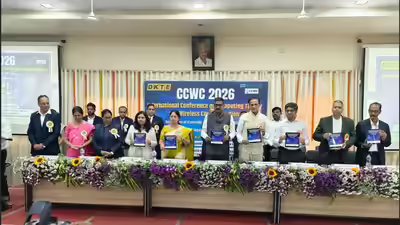
Pune: The IEEE International Conference on Computing, Communication and Web Technologies (CCWC 2026) announced its Best Paper Awards, recognizing two outstanding contributions that address some of the most pressing questions at the intersection of artificial intelligence, governance and next-generation computing infrastructure.The conference received approximately 3,434 submissions from researchers worldwide, of which only 266 were accepted after a rigorous multistage review, highlighting the event’s eclectic and technical depth, a statement released by the organizers said.A Best Paper Award went to “Governance-as-Architecture: A Framework for Compliance-Native AI in Regulated Large-Scale Data Ecosystems” by Sudhir Vishnubhatla. Analysts praised the paper for moving the AI governance debate beyond policy checklists and proposing a deeply engineered, compliance-oriented framework in which policy, controls and evidence become first-class architectural constructs rather than after-the-fact documents. This work introduces a multi-plane reference architecture—control, data, model, and decision planes—that demonstrates with exceptional clarity how policy code, defaults, model risk gates, and human anthropomorphic safeguards can be wired into large, distributed AI ecosystems to consistently enforce compliance. The committee noted that the paper “reads like an operating manual for regulators and chief data officers” and combines conceptual rigor with an implementation roadmap that is immediately relevant to financial services, healthcare, critical infrastructure and public sector AI deployments.The second best paper award went to Rajesh Kumar, Hemang Upadhyay, Chandra Prakash Pandey and Priya Ranjan Kumar on “Quantum Computing as a Service (QCaaS): Architecture, Orchestration, and Performance Trade-offs”. In a field often dominated by high-level commitments, this work stood out for its systematic, engineering-driven treatment of hybrid quantum-classical cloud platforms, from layered architectures and orchestration patterns to concrete performance and resource utilization analysis, the statement added. This paper presents a clear QCaaS stack—from user APIs and orchestration services to quantum processing units and cloud infrastructure—and then examines how scheduling, communication latency, error mitigation, and costware resource management shape real-world performance. By comparing classical, hybrid, and puricoquantum execution models and grounding the discussion in domains such as optimization, financial governance, ethical AI, and supply chain management, the authors provide what reviewers have called “one of the most practically useful blueprints for enterprises planning serious quantum experiments in the next decade.”According to the CCWC 2026 Technical Program Committee, the two winning papers stood out not only for their technical sophistication but also for the maturity of their insights and the clarity of presentation, turning the complex topics of regulatory-grade AI governance and quantum cloud computing into actionable guidance for practitioners, policymakers and industry leaders. The CCWC also features keynote speakers such as Rishiraj Kohli Independent Researcher, USA and Sumeer Basha Peta, Independent Researcher Massachusetts, United States.