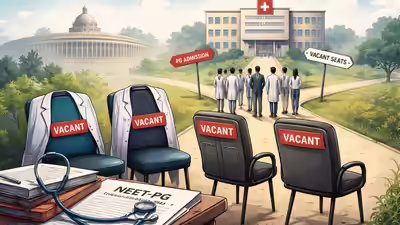
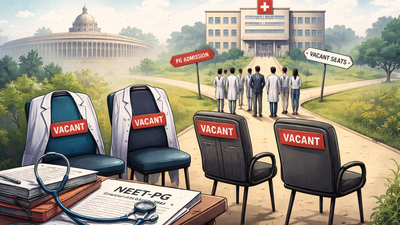
Despite a steep drop in the qualifying percentage for NEET-PG 2025, 1,140 postgraduate medical seats remained vacant after a wild round of counselling, according to a Rajya Sabha Reply Presented by the Union Ministry of Health on 17th March. The number is not high enough to cause panic. But it is important enough to keep alive an age-old question in medical admissions: If seats remain empty after repeated interventions, where is the problem?The government’s response this year was to widen eligibility. The ministry said the qualifying percentage was reduced to ensure that “valuable PG medical seats do not remain vacant”. For the 2025 admission cycle, the cut-off was raised above the 7th percentile for unreserved category and above the 5th percentile for UR-PwD candidates. SC, ST and OBC candidates were all declared eligible for counselling.Still the seats were not filled. This is what makes the latest data so important. A lower cutoff generally increases the pool of candidates available for allocation. Yet when vacancies persist, the problem seems to extend beyond internal boundaries. Parliament’s reply did not explain the reasons, but the data suggests that widening the eligibility alone has not solved the problem of vacancies in PG medical admissions.The matter came up through a question in Parliament which also asked whether the Center was considering shutting down NEET, declaring the exam to be external in nature. However, the government ruled out any such move and reiterated its support for NEET as a common admission procedure for medical admissions across the country. The ministry referred to the provision of Section 14 of the National Medical Commission Act, 2019, which provides for a uniform entrance test for undergraduate and postgraduate medical education. He described NEET as a “historic reform” that improved transparency and freed students from the responsibility of appearing in multiple entrance exams.This makes the current situation more layered than a simple discussion on the exam. In theory NEET is still non-negotiable. This is supported by the NMC framework provided in the Act. It is still being sold in political parlance as a vehicle for reform. But the number of vacancies placed before Parliament shows that the admissions system faces a problem that cannot be solved by legal defenses alone.Part of this complexity lies in how counseling itself is organized. The reply noted that the Medical Counseling Committee (MCC), under the Directorate General of Health Services, conducts counseling for 50% of the All India Quota seats and 100% of the seats in Central and Deemed Universities. State governments conduct counseling for state quota seats, while state counseling authorities also handle admissions to private medical colleges.This fragmented structure means that the problem of vacancy does not sit under one office or one authority. Eligibility may be national, but allocation and uptake are spread across multiple layers. When seats remain vacant after repeated rounds of counselling, the issue may not only reveal who is allowed to contest, but also where the seats are, how they are priced, and how candidates perceive them.However, the ministry’s response does not consider these factors. It limits itself to numbers, reduction in percentages, and defense of NEET by the government. But taken together, these details point to a broader challenge in the PG medical admissions process. If seats remain vacant after sharply lowering the qualifying bar, the problem is unlikely to be explained by access alone.For now, the Centre’s stand is clear: NEET remains intact. The big question is whether the system around it is working as intended.